
 Women in the Triangle know that medical tests are essential for detecting breast cancer as early as possible, so we get annual mammograms and other exams recommended by healthcare providers.
Docs often recommend a specific combination of tests based on a woman’s unique situation. These may occur as part of breast cancer screening, diagnosis, treatment or follow-up care and monitoring.
From our friends at Breastcancer.org, here’s a glance at some of them.
Biopsy
A breast biopsy is the only exam that can tell for sure if an area of concern - for example, a spot flagged on a mammogram - is cancer. During this procedure, a doctor removes a small sample of tissue, cells or fluid from the suspicious area so it can be examined in a lab under a microscope.
The doctor may also biopsy the lymph nodes under the arm to see if cancer has spread there.
Blood chemistry tests
Blood chemistry tests measure the levels of specific substances in a sample of blood, such as glucose (sugar), calcium, potassium and liver enzymes. The assessments can help tell how well organs are functioning during treatment for breast cancer.
Also, abnormal results can indicate that breast cancer may have spread to the liver or the bones.
 Breast MRI
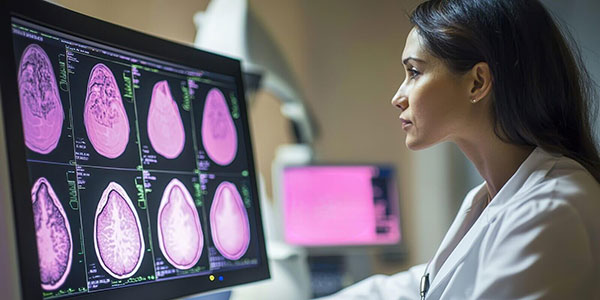
Breast MRI (magnetic resonance imaging) uses magnets and radio waves to produce detailed cross-sectional images of the inside of the breast. This procedure may be used in addition to mammograms to screen some people for cancer.
Breast MRI is also used to find out the extent of breast cancer, track treatment response and guide the position of a needle during a biopsy.
MRIs also may be done to see if breast cancer has moved into other body parts or to monitor an area where it has spread.
Chest X-rays
A chest X-ray produces an X-ray picture of the heart, lungs, blood vessels and other organs and structures inside the chest. A chest X-ray may be done to check whether breast cancer has spread to the lungs or to see how it’s responding to treatment.
The procedure also can identify lung inflammation following treatments.
 CT scans
A CT scan (also called a CAT scan, or computerized tomography scan) is an X-ray technique that produces detailed cross-sectional images of the inside of the body. A CT scan may be used to check whether breast cancer has spread to other parts of the body.
It also may be used to see whether metastatic breast cancer is responding to treatment. A CT scan is sometimes combined with a PET scan. (This is called a PET/CT scan.)
Diagnostic tests
Diagnostic tests, such as breast biopsy, are done when your doctor suspects you may have breast cancer (either because of your symptoms or the results of a screening).
These exams are used to determine whether the illness is present and, if so, whether it has spread outside the breast. Diagnostic inquiries also are used to get more information about the cancer to guide decisions about treatment.
Genetic tests
Genetic tests can help identify gene mutations that are linked to a higher risk of developing cancer. The results of these reviews can guide efforts to prevent breast cancer or help steer treatment decisions if you have it.
Genomic tests
Genomic tests (also known as genomic assays) are used to learn about genes in a breast tumor to predict how likely it is that the cancer will grow, spread or come back after treatment.
Genomic inspections can help a doctor determine the types of targeted therapy most likely to work on a specific cancer.
 Mammograms
A mammogram - the most commonly used imaging method for detecting breast cancer - is an X-ray picture of the breast tissue.
Two types of mammograms are widely available: 3D mammograms (also known as digital breast tomosynthesis, or DBT) and conventional 2D digital mammograms. Studies show that 3D mammograms can detect more cancers earlier - with fewer false positives - than 2D digital mammograms.
Physical exams
Physical exams of the breast can be done by a healthcare provider, and on your own, to check for changes in the breast tissue.
Prognostic and predictive tests
Prognostic tests provide information about how likely the cancer is to grow, spread or come back after treatment. Predictive tests help doctors think about how specific treatments might affect the progression of disease.
Some investigations are both prognostic and predictive - they’re used to assess whether certain treatments would reduce the risk of breast cancer coming back.
Molecular breast imaging
Molecular breast imaging (MBI) is a newer type of exam for finding areas of cancer in the breast. MBI is sometimes used to screen people who are at high risk for breast cancer, but who can’t have a breast MRI (because, for example, they are allergic to the contrast solution used).
Also, it may be employed to assess a suspicious area spotted on a mammogram.
Monitoring tests
Monitoring tests are used during and after treatment to check how well the approach is working. Monitoring also may be used to look for signs of cancer coming back.
PET scan
A positron emission tomography (PET) scan can detect areas of cancer in the body. PET scans are typically done after cancer has been diagnosed to determine if the disease has spread or to see if it’s responding to treatment.
A PET scan is sometimes combined with a CT scan (this is called a PET/CT scan).
Screening tests
Routine screening, such as yearly mammograms, are done to find cancer in a timely manner, before any symptoms develop. If the disease is caught quickly, it may be easier to treat.
 Ultrasound
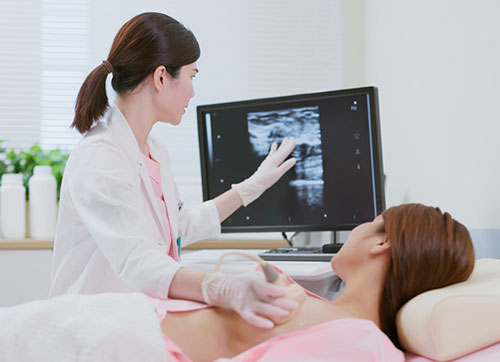
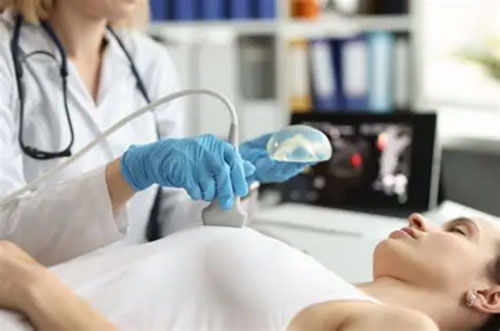
Ultrasound sends high-frequency sound waves to create a digital image of the inside of the breast. Doctors draw on ultrasound to find out if a lump that was detected on a mammogram or felt by physical exam is solid (such as a cancer) or fluid-filled (such as a benign cyst).
Ultrasound also is put into play as a screening tool, particularly in women with dense breast tissue. It’s not considered a substitute for mammograms but may be used in addition to them. Also, ultrasound may be used to help locate a suspicious area in the breast or lymph nodes during a biopsy.