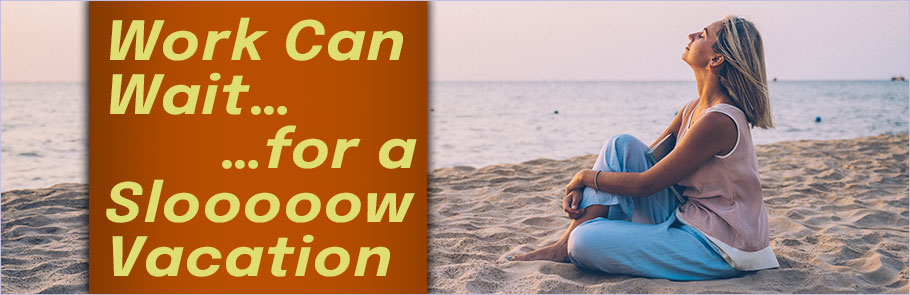
 Take a deep breath. It’s summer in the Triangle. Time to slow down.
The root of the word “vacation” comes from the Latin for “vacate,” to create a vacuum.
Often, however, we seem to forget how to take a break after running full speed all year and checking off unrelenting to-do lists.
U.S. workers receive fewer paid vacation days than Europeans. Even when U.S. workers have paid time off, nearly half report not using all their days.
When they do take time off, about 1 in 4 Americans still check in on work. With that kind of seepage, no wonder vacation itineraries begin to resemble work agendas, with every minute made to count.
“In our productivity-driven society, we tend to forget that vacation isn’t about output,” says Joe Robinson, a work-life consultant and author of “Work to Live.”
It’s about play and about leaving time for serendipity, he says.
It’s also about health: At least two studies have shown a correlation between the stress reduction of annual vacations and lower rates of coronary heart disease.
“Our bodies are designed to recover; that is basic biology,” points out Wolfgang Linden, professor emeritus at the University of British Columbia, who studies psychology and its intersection with cardiology. “You need a reprieve.”
 Though wanderlust may take you around the world, your own backyard can provide respite.
“There’s a taboo against slow, that it’s a four-letter word, as opposed to busy, which is a badge of honor,” says Carl Honore, author of “In Praise of Slowness: Challenging the Cult of Speed.”
What Honore calls the “slow ethos” does not mean moving at a snail’s pace. Rather, he explains, it’s “doing things as well as possible instead of as fast as possible.”
For example, the following is not relaxing for most people: On the last day of vacation, rising early to catch the last local landmark on your list, then hustling from a yoga class to a Pilates session to a swim in the pool, and rushing to pack a bag before hopping in an Uber to the airport for a flight spent furiously catching up on a laptop.
In life in general, not just on vacation, Honore asserts, “We don’t get the full pleasure because we don’t take time in between activities to decompress, to reflect on and enjoy what we do.”
Increasing numbers of fast-track women are getting fed up with time-deprived living and are embracing that idea. That’s why the concept of slow travel has developed. It’s not just a less hectic vacation; it’s a different style of going on holiday.
“You stay in one place and pretend you live in the area and do all the things the locals do,” explains Pauline Kenny, who founded a slow travel website after coining the term.
It’s the opposite of what she calls “zoom” travel. That’s the “If it’s Tuesday, this must be Belgium” mode in which you pack and unpack in a different place every day.
Instead, you establish a home base (say, at an AirBNB or bed-and-breakfast) for a week or more and then branch out to explore close-by surroundings.
 Kenny emphasizes that traveling in the languid lane doesn’t mean driving to a destination under the speed limit. It simply encourages moving at a slow and steady pace that allows you to complete each day feeling refreshed rather than depleted.
“Everyone needs to figure out what they want from a trip, what interests them and make their own ‘must sees,’” Kenny says.
Her list includes taking walks, exploring neighborhoods, buying local produce and experimenting with regional recipes. Yet, even when the sense of quiet is sublime, our internal beeping and blinking often ruins the mood.
“Multitasking is endemic to our culture and infects our recreational experiences,” explains Jeffrey Kottler, a professor emeritus at California State University and author of “Travel That Can Change Your Life.”
“It’s not enough, we think, to just be with the family or sit on the beach or hike,” Kottler explains.
Even while we are away from work, we measure ourselves by how in demand we are.
“We have a culture of bootstrapped ambition and, often, unacknowledged status anxiety turns even leisure activities into arenas of achievement,” says Tom Lutz, author of “Doing Nothing: A History of Loafers, Loungers, Slacks and Bums in America.”
The bottom line: Consider it an achievement the next time you’re able to turn even a quick getaway into a slooooow vacation.